
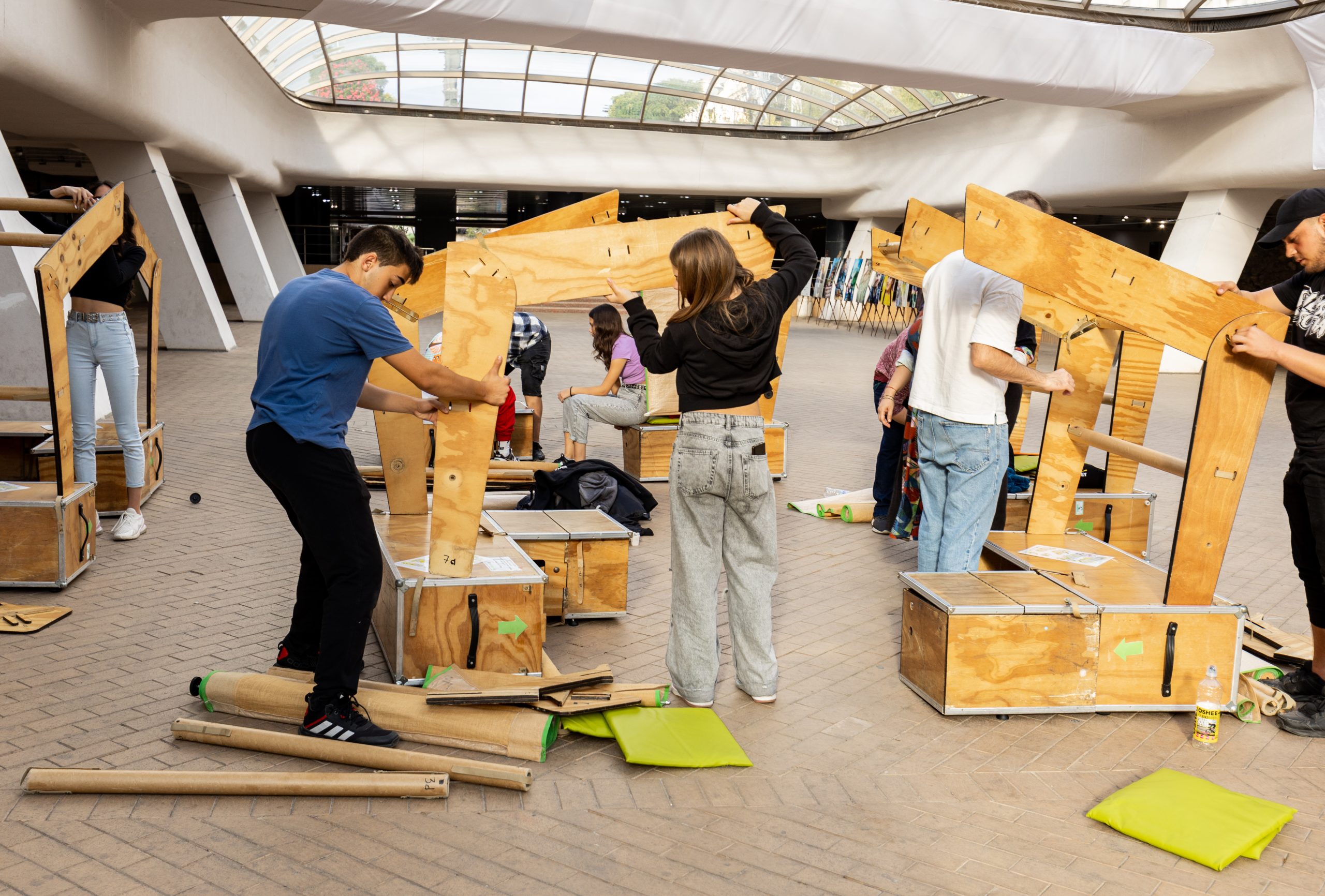
Picture: The Beit Project, building Nomadic School
The Beit Project was born in 2010 from a simple yet powerful idea imagined by Paideia alumnus David Stoleru: transforming the city itself into a place of encounter, dialogue and shared learning. Created in Barcelona together with Pierre-Antoine Ullmo and Carles Basteiro, the project originally focused on sites connected to Jewish heritage across Europe—hence its name, inspired by the Hebrew letter Beit, a symbol of “home”.
The project was developed that same year, first within the Mandel Institute and then within Paideia. Paideia remained in close contact with the association through several collaborations.
From the outset, the project combined urban exploration, intercultural dialogue and an innovative pedagogical approach. In 2011, the team designed the first modular, mobile “Nomadic School”, created by Virginie Manuel and Fabien Asunción, with educational methodology developed with Eli Holzer. That same year, the very first pilot took place in Paris, in the historic Cloître des Billettes.
What followed was an extraordinary European journey.
Between 2012 and 2015, The Beit Project expanded to Barcelona, Rome, Brussels, Berlin, London, and Łódź, gradually opening its scope to all urban sites carrying stories of diversity, coexistence, and discrimination—not only Jewish heritage. This marked a turning point: the project became a platform for young people to reshape their understanding of the city and of one another.
From 2016 onward, the network grew across Europe and the Mediterranean: Marseille, Tangier, Sofia, Skopje, Athens, Nice, Bucharest, Iași, Nantes, and many others. European partnerships strengthened, and the association received its first EU support through “Europe for Citizens” (2014) and later CERV (2021). A French branch was created in Marseille in 2021.
In 2022, The Beit Project launched a new artistic and educational adventure: The Boat Project, developed with the Matanel Foundation – bringing together cities across the Mediterranean (Marseille, Barcelona, Bastia, Tangier and Tunis) through a shared boat serving as a maritime experiential school of coexistence.
Today, the association continues to innovate with large-scale programs such as the Nomadic Mediterranean School for Living Together (from 2024 onward) and new pilot initiatives in Marseille and beyond. In 2025, The Beit Project also received the high patronage of the French Minister for Equality and Anti-Discrimination, marking a new milestone in its public recognition.
During 15 years of its existence, The Beit Project has become a unique European movement, building spaces where young people learn to listen, reflect, challenge their assumptions, and build a shared culture of coexistence.
Key figures today:
- 92 projects carried out in 20 cities
- 12,800 young participants, 300 teachers, 350 schools
- 300 local team members, 200 partners, more than 15,000 people interviewed
- Over 3,000 short films created by participants
At its heart, The Beit Project is still driven by the same conviction that started it all:
Living together must be learned, experienced, and built… one encounter at a time.